
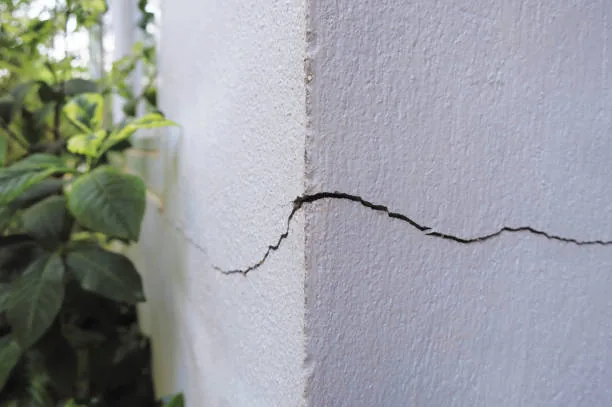
Signs of foundation problems — and what each one means.
Most Northwest Arkansas foundations send warning signals long before catastrophic failure. Catching them early is the difference between a small repair and a full underpinning project.
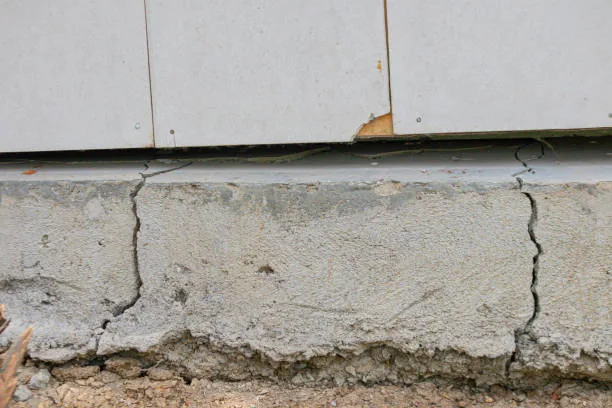
Stair-step or diagonal cracks in brick or drywall
MeasureCracks that climb at a 45-degree angle across brick mortar joints or diagonally above doorways and windows are classic structural settlement indicators — different from cosmetic surface cracks.
Check it yourself: Crack width is the tell. Under 1/16 in and stable is usually cosmetic; 1/4 in or wider, or a crack where one side sits proud of the other, is structural movement. Pencil the date at each end and re-measure monthly.
Sticking doors and windows
MonitorIf doors that worked fine last year now stick, won't latch, or have visible gaps at the top corner, the frame has moved with the foundation underneath it.
Check it yourself: Check the gap along the top of the door. A wedge-shaped gap — tight on one side, open on the other — means the frame is out of square, not that the timber has swollen. Humidity sticks a door evenly; settlement does not.
Sloping or uneven floors
MeasureA noticeable slope across a floor, or a ball that rolls on its own, indicates differential settlement — one part of the slab or pier system has dropped relative to another.
Check it yourself: Roll a marble across the room from several starting points. Consistent drift in one direction is differential settlement. A 4 ft level with a shim under one end will tell you roughly how much fall you have per foot.
Gaps at baseboards, crown molding, or trim
MonitorVisible gaps appearing between trim and the wall, or between baseboards and the floor, mean the structure is pulling apart at the joints.
Check it yourself: Slide a business card into the gap. If it disappears, the joint has opened more than most seasonal timber movement accounts for — especially if it is worse on one elevation of the house than the others.
Bowing or leaning foundation walls
Call nowInward bowing in a basement or crawl-space wall, especially with horizontal cracking, signals lateral soil pressure exceeding the wall's design.
Check it yourself: Hold a string line or long level vertically against the wall. Any visible bow, and particularly a horizontal crack running along the middle third of the wall, means lateral soil pressure is winning. This one does not wait.
Sagging floor joists or bouncy floors
MeasureIn crawl-space and pier-and-beam homes, sagging joists and 'bouncy' floors usually trace to moisture-driven wood deterioration plus pier settlement underneath.
Check it yourself: In the crawl space, look for daylight gaps between piers and girders, rust or damp on the shims, and any joist you can press a screwdriver tip into. Soft wood means moisture got there first.
Cracks in exterior brick or chimney pull-away
Call nowVisible separation between the chimney and the house, or staircase cracks down the brick veneer, is structural — not weather damage.
Check it yourself: Measure the gap between the chimney and the wall at the top and the bottom. If the top gap is wider, the chimney is rotating away from the house — a structural condition with a flue and fire-safety dimension on top of the foundation one.
Doors that won't latch or windows that won't close
MonitorWhen the frame is out of square with the rough opening, latches miss and windows bind. The cause is almost always foundation movement.
Check it yourself: Note which rooms. Symptoms clustered on one side or corner of the house point to a single settled elevation, which is a much cheaper problem than symptoms scattered evenly throughout.
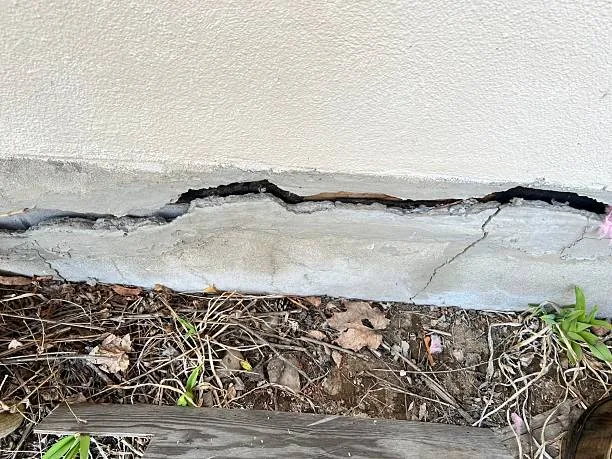
Triage: how urgent is what you are looking at?
Not every crack is an emergency, and treating them all as one is how homeowners end up buying repairs they did not need. Sort what you are seeing into one of three buckets.
Document it and watch for a season.
Hairline cracks under 1/16 in, doors that stick only in humid months, a single gap at one length of trim. Photograph each one with a ruler or coin in frame and a date, then look again after the next wet-to-dry swing. Most of these never become anything. The ones that do announce themselves by widening.
Get a documented elevation baseline.
Cracks wider than 1/4 in, visible floor slope, symptoms clustered on one elevation, or anything that has clearly moved between two photographs. You are past what eyeballing can settle. A laser elevation survey turns an argument about whether the house is moving into a number — and if it turns out to be nothing, you have a dated baseline for the next time you wonder.
Do not wait for a convenient week.
A bowing or leaning foundation wall, a horizontal crack through the middle of a basement wall, a chimney rotating away from the house, a crack you can see daylight or soil through, or any sudden change over days rather than seasons. These are conditions that can progress quickly and, in the case of leaning walls and chimneys, carry a safety dimension beyond the foundation itself.
Five checks you can do this weekend
None of these require a contractor, and all of them produce evidence that makes a later inspection faster and cheaper. Do them before you call anyone.
- 1
The marble test
Roll a marble or a ball bearing across each main floor from several different starting points. Consistent drift toward the same wall is differential settlement; random directions are just an old floor.
- 2
Measure and date every crack
Photograph each crack with a coin or tape measure in frame, and pencil a small dated tick at each end. Re-shoot in three months. A crack that has not moved is a very different conversation from one that has, and no inspector can reconstruct that history for you after the fact.
- 3
Read the door gaps
Look along the top edge of every interior door. A parallel gap is normal. A wedge — tight at one corner, open at the other — means the opening is out of square, and the pattern of which doors do it maps roughly onto which part of the house has moved.
- 4
Walk the perimeter in the rain
The most useful ten minutes on this list. Watch where roof water actually goes: downspouts discharging at the footing, ground sloping back toward the house, water standing along a wall. Water is the mechanism behind most NWA foundation movement, and this is where you see it working.
- 5
Open the crawl space
Musty air, condensation on the underside of the subfloor, standing water, rusted shims, or wood you can press a screwdriver into. Moisture damage down here shows up as bouncy floors upstairs long before anyone thinks to blame the foundation.
What early detection is actually worth
The gap between the cheapest and the most expensive version of this problem is mostly time. A dropped slab edge caught in its first season is often foam lifting and a downspout extension. The same elevation left for six years is engineered piers, interior finish repair, and a disclosure line on the eventual listing. The published ranges on the cost page put roughly an order of magnitude between those two outcomes.
It is also worth knowing what is driving the movement in the first place — in most of Northwest Arkansas that is cherty clay working against a seasonal moisture cycle, which is why symptoms so often appear in a dry late summer and partly close up again over winter. A foundation that looks better in February has not repaired itself.
Still unsure which category you are in? Work through normal settling versus a real foundation problem, then read what actually happens during a foundation inspection before booking one. And since most of this is driven by water, the drainage fixes that prevent it are the cheapest place to start.
Get a documented engineering baseline before it gets worse.
Or read about typical the soil behind most NWA movement, or foundation repair cost factors and how a warranty-backed repair protects the spend.